
My Cart
Order Note


Mattress

Recliner Sofa

Chair

Desk

Elite Sofa

Massager

Recliner Bed

Pillows

Cushions

Bedding
Mattress
Recliner Bed
Recliner Sofa
Elite Sofa
Chair
Desk
Bedding
Pillow & Cushion
Massager
Mattress
Pillow & Cushion
Chair
Desk
Recliner Sofa
Recliner Bed
Elite Sofa
Bedding
Massager
Talk to Us
Get Help Choosing the Right Product

Stores near you
Find and visit our experience stores
Request a call back
Talk to our experts about our products
For your New Home
Find the perfect mattress - chat now


My Cart


Three mornings of waking up stiff and most people start blaming the gym, the commute, or how they sat at their desk. The mattress barely gets considered. But for anyone on a surface that fails to keep the spine in its natural position for seven to eight hours, the damage accumulates quietly, a dull ache by 7 AM, a lower back that needs twenty minutes to loosen, fatigue that eight hours of sleep doesn't fix. These aren't random complaints. They're what poor spinal alignment during sleep looks like, and the mattress is responsible far more often than people realise. Searching for the best mattress for back pain rarely starts here, with understanding what went wrong overnight.

The spine isn't straight. It has three curves, inward at the neck, outward across the upper back, inward again at the lumbar. These curves aren't flaws; they're structural. They distribute load, absorb impact, and allow movement. During sleep, a mattress for spinal alignment does one essential job: it holds those curves in their natural position rather than collapsing, exaggerating, or flattening them over hours of sustained pressure.
Too soft and the hips drop, the lumbar curve flattens, and the lower back holds a position it was never meant to sustain. Too firm without adaptive give, and the shoulder and hip bear all the contact pressure while the spine sits rigid against the surface. Both situations produce the same result through different mechanisms, the back muscles work instead of resting, and morning stiffness is what seven hours of that unrecognised labour costs.
A mattress that genuinely supports spinal alignment must cushion contact points and back the lumbar zone simultaneously, competing demands that most foam or coir mattresses only half-meet. When people finally find the best mattress for back pain, the difference is how precisely the surface handles both at once. The full picture of back pain and morning stiffness from a mattress failing at this dual requirement is worth reading before any purchase decision.
Signs of bad mattress posture are easy to misread. They don't feel like a mattress problem. They feel like age, stress, or a long week.
The most reliable early indicator is lower back stiffness on waking that disappears within an hour of being upright. The spine was held in misalignment during sleep; once vertical movement redistributes the load, the discomfort fades. If the pain is gone by mid-morning, the sleeping surface produced it. This is one of the clearest signs of bad mattress posture and one of the most commonly dismissed.
Frequent position changes through the night are a signal most people don't connect to the mattress. A well-supported body finds a position and stays. A body searching for pressure relief shifts repeatedly without the person consciously waking, and sleep quality suffers because of it.
Side sleepers who develop shoulder or hip soreness on their contact side are on a mattress too firm for their body weight, the joint bears load it should be cushioned from for six or seven hours. That's a material failure. Catching these signs of bad mattress posture early matters; the longer the surface stays wrong, the more surrounding muscles adapt around the misalignment. Knowing the best sleeping positions for lower back pain helps assess whether position is compounding a mattress problem or the mattress is the primary issue.
Persistent tiredness after a full night is the most under-recognised sign. If the muscles that hold the spine in position never fully relax, because the mattress isn't doing that job, they never truly recover. The body was asleep. The muscles weren't. A proper mattress for spine support takes that load off entirely, and the improvement in morning energy is often noticeable within the first two weeks.
People dealing with mattress for lower back pain often go straight for the firmest option they can find, an understandable instinct and frequently the wrong one.
Firmness controls how far the body sinks, not whether the spine is supported. A very firm surface can still produce mattress for lower back pain because it holds the body rigid without filling the lumbar gap, that inward curve that needs support, not pressure. An overly hard surface under a back sleeper pushes the lumbar region into extension, loading the posterior joints in a way that builds pain through the night.
A proper mattress for spinal alignment at the lumbar zone needs adaptive firmness, not blanket hardness, fill and backing that meets the inward curve and holds it there. This is why a firm mattress for back support is not the same as the right mattress for back pain; one is a surface property, the other is an engineering outcome.
Body weight changes what a mattress for spinal alignment actually delivers. A 65 kg and a 90 kg sleeper on the same product aren't on the same mattress, the heavier person compresses the layers more, shifting the feel toward soft. For anyone above 85 kg dealing with mattress for lower back pain, medium-firm on a label often performs like medium-soft in practice, and the real fix requires a firmer base with pressure relief built into the construction. A detailed breakdown of what type of mattress is best for lower back pain explains how firmness and targeted lumbar support differ in practice across body types.
The word "orthopedic" isn't regulated, so it can be printed on virtually anything. The real orthopedic mattress benefits come from structural zoning, different firmness levels across different body regions so the lumbar area gets firm backing without forcing the same rigidity on the shoulders and hips. A genuine firm mattress for back support achieves this through zoned construction, not by hardening the entire surface equally. Knowing which orthopedic mattress benefits are real versus marketing is the most useful thing a buyer can do before spending money.
The Smart Ortho GRID Mattress is built around this principle. Ortho Balance Foam and SmartGRID® technology work together to keep the back firmly held while the polymer grid compresses under the wider contact zones at the hips and shoulders. It's been tested across 30,000+ sleep hours and carries AIHA certification from the All India Health Association's doctors and scientists, which is a meaningful distinction in a category full of unsubstantiated claims. For anyone looking for the best mattress for back pain with genuine clinical backing, that certification matters.
For anyone with chronic lower back strain or a history of disc issues, the Smart Ortho Pro Mattress carries that zoning considerably further. Its 5-zone orthopedic support layer treats the head and neck, shoulders and upper back, lower back and hips, upper leg and knee, and lower leg and ankle as independent zones, each receiving the support level appropriate to that region rather than a one-firmness-fits-all surface. The lumbar zone stays firm. The pressure zones cushion. These aren't the same requirement, and this mattress doesn't treat them as if they were.
SmartGRID® is what makes the pressure-relief side of a mattress for spinal alignment work without compromising lumbar support, and it's one of the orthopedic mattress benefits that separates polymer grid construction from foam in a way that matters across a full night. The hyper-elastic polymer grid collapses under soft tissue and stays firm under structural zones independently of body temperature. Memory foam softens as it warms, so lumbar support at midnight differs from support at 4 AM. SmartGRID® doesn't shift, the support at the start of sleep is the same at the end.
Sleep position shapes what mattress for spine support actually requires. Back sleepers need the lumbar backed without excessive firmness pushing it into extension. Side sleepers need the shoulder and hip cushioned enough to decompress those joints. Stomach sleepers need firmness to prevent the pelvis sinking further into lumbar compression. Getting this match right is where finding the best mattress for back pain for a specific body really starts. The full guide on strategies to prevent back pain during sleep covers position-specific guidance alongside mattress choice.
A mattress for spinal alignment that only works in one position isn't doing its job. Most people shift during sleep, and the surface needs to maintain reasonable alignment wherever the body settles by 2 AM.
Durability is the factor most buyers underweight. The best mattress for lower back pain in year one can become the source of it by year three if the materials have compressed permanently at the primary sleep zone. Memory foam and coir sag over time, and the dip is usually invisible until it's significant. Rotating every three months delays this, but material quality is what determines how long a firm mattress for back support actually holds its shape.
The 100-night trial across the full orthopedic mattress range matters more than it seems. The body takes two to three weeks to adapt, and early discomfort during that window isn't a sign the mattress is wrong. A mattress for spine support that feels unfamiliar in week one may be exactly right by week three. This is especially true for first-time buyers of a firm mattress for back support, the initial firmness reads as unusual before the body recognises it as actual support. More on construction differences in the orthopedic mattress complete guide.
Most likely, yes. Eight hours in bed is not eight hours of recovery if the muscles holding your spine in place never get to fully switch off. A surface that doesn't support spinal alignment keeps those muscles working through the night at low intensity. Once the mattress takes over that structural job, the muscles genuinely rest, and the exhaustion on waking tends to clear faster than people expect.
You're probably shifting positions during sleep without realising it. A mattress may hold your spine well on your back but fail when you roll to your side, and that shift happens without you waking up. Inconsistent pain is a sign the surface is selective, it supports one position but not others. A mattress for spinal alignment needs to work regardless of what position the body shifts into through the night.
Age isn't the only measure. A mattress that was never the right fit for your body type causes problems from week one, not year five. And without regular rotation, foam layers can start compressing unevenly within eighteen months, especially for sleepers above 80 kg. Visible sagging is usually the last sign, not the first. By the time you can see it, the support has already been compromised for a while.
Firmness is a hardness setting. Orthopaedic is an engineering approach. A very firm surface keeps you from sinking, but it doesn't mean the spine is aligned. A properly built orthopedic mattress zones its support, firm under the lower back where structure is needed, softer under the hips and shoulders where pressure relief matters. Those are opposite requirements, and blanket firmness can't serve both at once.


Workouts challenge your body in the best possible way. Whether you are strength training, running, cycling or...
Read More
Written by Dipti Mestry Pregnancy can bring many wonderful changes, but it can also bring a few...
Read More
Written by Dr. Aishwarya Panchal One of the most common assumptions I hear from patients with back...
Read More
Most people shopping for a new mattress in India right now compare two very different surface categories....
Read More
Buying a new mattress and realising the size is wrong is one of the most avoidable life...
Read More
Most mornings the ache between your shoulders or lower back fades by mid-morning and you chalk it...
Read More
There is a surface in almost every Indian home pressed against the body for seven or eight...
Read More
Most people press down on a few mattresses in a showroom for ten minutes and spend the...
Read More
Waking up with a stiff back, a numb shoulder, or that dull ache below the hips does...
Read More
Most adult children notice the signs long before their parents do. A parent who used to sleep...
Read More
Picture a household in a coastal Indian city where one family member starts waking up congested every...
Read More
Spring mattresses are the common choice across most Indian households and have been for decades. They are...
Read More
Walk through any Indian apartment building between May and August and the pattern is identical from floor...
Read More
The bed frame size printed on a purchase receipt is often the only number a buyer brings...
Read More
Most people buying a mattress spend more time testing surface feel than thinking about what the sleeping...
Read More
Walk into most Indian homes and ask about the mattress, and the answer follows a familiar pattern:...
Read More
Walk into any mid-size Indian city's furniture market and the inventory looks roughly the same as it...
Read More
Most Indian households buy a new mattress when the old one becomes obviously unusable a visible sag,...
Read More
Indian summer nights are not simply warm they are a specific combination of heat above 35°C, relative...
Read More
Walk into any furniture showroom and ask about the best mattress for kids, and the answer almost...
Read More
Your kid sleeps more than you do. Ten to twelve hours daily for school-age children. During...
Read More
What Is an Orthopedic Mattress? Quick Answer: An orthopedic mattress is a sleep surface specifically designed for...
Read More
Memory foam changed how people think about mattresses. The material moulds to body shape in ways traditional...
Read More
Queen Size Mattress Dimensions Quick Answer: The standard queen size mattress dimension in India is 72 x...
Read More
Cooling Mattress Topper: Technologies, Types and How to Choose Memory foam mattress owners in India report sleeping...
Read More
Most couples don't realize their sleep problems stem from their mattress until one partner starts waking up...
Read More
A 68-year-old man complained about his back for three years straight. Three years. His family tried everything,...
Read More
Which Mattress Is Good for Health: Your Complete Guide to Peaceful Sleep in 2026 Most people spend...
Read More
Best Cooling Mattress for Hot Sleepers in India Walk through any Indian apartment building between May and...
Read More
MS Dhoni is not just your average Indian cricketer. Loved from all the corners of the nation,...
Read More
MS Dhoni’s Sleep Routine and the Meaning Behind ‘8’ MS Dhoni’s quiet decision to swap his jersey...
Read More
Waking up with a stiff back ruins your entire day, doesn't it? You drag yourself out of...
Read More
Latex vs Memory Foam Mattress: Which Is Better for Back Pain? It's already midnight. You are tossing...
Read More
What Is a Mattress Topper? Benefits, Types & How to Choose the Best One in India Your...
Read More
Foam Mattress vs Spring Mattress: Which Mattress Type Suits You Best? Your mattress affects your sleep quality...
Read More
Tips for Choosing the Right Mattress for Old People: A Complete Guide A 68-year-old man complained about...
Read More
Choosing the right mattress size affects your sleep quality more than most people realise especially in Indian...
Read More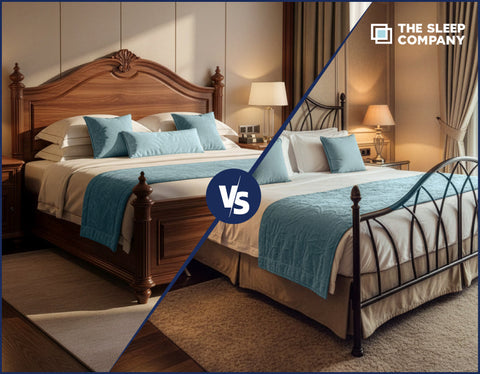
Here's something most people don't think about: your bed frame isn't just holding up your mattress -...
Read More
You've probably had this thought at least once, why does every hotel bed feel amazing while your...
Read More
Your mattress is probably the second-biggest purchase you’ll make after a car or home, somewhere between ₹15,000...
Read More
Your mattress collects roughly 500 million skin cells every year. Not a typo. That's half a billion...
Read More
What is SmartGRID? A Revolution for the Mattress Industry/Comfort Industry SmartGRID is designed with Japanese Patented Technology...
Read More
A major shift is underway in the mattress sector in India. Most Indians are ditching legacy mattress...
Read More
Do you wake up every morning with a serious dose of back pain? Then, a good orthopedic...
Read More
Queen Vs King Bed: Complete Size Guide for Indian Bedrooms Choosing between a queen bed vs king...
Read More
The 2025 GST overhaul brings clarity and efficiency to Indias tax landscape, placing mattresses squarely under the...
Read More
Which Mattress is Good for Health? Discover Several Benefits and How to Choose the Right One Do...
Read More
Soft, Medium or Firm Mattress (2025), Which is Best For You? Most people discover their mattress firmness...
Read More
Choosing the best mattress in India isn’t as simple as it seems. We get it! With countless...
Read More