
My Cart
Order Note


Mattress

Recliner Sofa

Chair

Desk

Elite Sofa

Massager

Recliner Bed

Pillows

Cushions

Bedding
Mattress
Recliner Bed
Recliner Sofa
Elite Sofa
Chair
Desk
Bedding
Pillow & Cushion
Massager
Mattress
Pillow & Cushion
Chair
Desk
Recliner Sofa
Recliner Bed
Elite Sofa
Bedding
Massager
Talk to Us
Get Help Choosing the Right Product

Stores near you
Find and visit our experience stores
Request a call back
Talk to our experts about our products
For your New Home
Find the perfect mattress - chat now


My Cart


The 2025 GST overhaul brings clarity and efficiency to Indias tax landscape, placing mattresses squarely under the 18% GST slab. For the mattress industry, this means both fresh opportunities and some persistent challenges as brands navigate a fast-growing market where health, digital innovation, and organized retail are setting new standards.
Indias GST overhaul, effective from September 22, 2025, replaces the previous multi-slab system (5%, 12%, 18%, 28%) with a rationalised structure: 5% for essentials, 18% for standard goods, and a new 40% rate for luxury/sin goods. This change is designed to make tax administration easier, close loopholes, and reduce disputes while boosting consumer trust and business efficiency.
The mattress industry in India is a billion-dollar marketplace projected to reach USD 2.4 billion in 2025 and grow at 8.8% CAGR through 2030. Foam mattresses are the dominant category, with residential buyers accounting for nearly 80% of revenue. Demand is fueled by rising urban incomes, growing health consciousness, and the shift to organized, branded sales.
Mattresses remain in the 18% GST bracket, unchanged, but now much clearer in the new structure. This high rate:
1. Health and Wellness-led Growth: Sleep health campaigns and doctor endorsements are driving demand for orthopedic and memory foam mattresses, doubling annual searches for these formats. Millennials and Gen Z, with higher disposable incomes, lead the trend for customized and tech-enabled sleep products.
2. Digitization, D2C, and E-commerce: Online sales, virtual consultations, and algorithm-driven recommendations are making mattresses more accessible, cutting out retail markups and speeding delivery. D2C models help brands offer transparent GST-compliant pricing, faster service, and better customer support.
3. Experience Centers and Retail Innovation: Brands are opening more physical stores and sleep experience centers for hands-on trials, expert advice, and AR previsualisation.
4. Organized Sector Advantage: As consumer awareness rises, buyers are shifting from unorganized to branded options, accelerating organized sector growth. Compliance and digital invoicing under GST allow easier warranty and refund processes, boosting consumer trust.
The mattress industrys future is bright, with annual demand for new units reaching nearly 7 million and total market sales at 18.6 million units. GST overhauls reduction of classification ambiguity favors organized, innovation-driven brands, though persistent high taxation still holds prices up for entry-level shoppers. Trends like personalized sleep solutions, eco-friendly materials, and omni-channel retail are set to accelerate, while policy changes around GST refunds, lower input slab rates, or sustainability incentives could further unlock growth.
The 2025 GST overhaul simplifies taxation, strengthening organized retail, digitization, and premium product demand in Indias mattress industry, but it keeps the core rate at 18%, making affordability and price gaps with the informal sector a continuing challenge. Success will come to brands that combine compliance, technology, wellness-focused marketing, and innovative customer experiences—ushering in a new era for sleep and home comfort in India.
No, the core 18% GST rate remains unchanged for mattresses. Related furniture items made by hand or classified differently may move to 5%.
Water and pneumatic mattresses: 12% Standard foam, coir, and spring mattresses: 18%.
Not directly, since the rate remains 18%. However, streamlined vendor costs and easier compliance may help brands offer better deals over time.
Simplified input credits, uniform taxation, and digital invoice systems will reduce compliance headaches and make refunds/claims faster for brands using online platforms.
Unorganised players, who often operated outside GST compliance, may face pressure to join the formal sector as enforcement gets easier. This shift benefits reputable brands and enhances consumer safety.


Workouts challenge your body in the best possible way. Whether you are strength training, running, cycling or...
Read More
Written by Dipti Mestry Pregnancy can bring many wonderful changes, but it can also bring a few...
Read More
Written by Dr. Aishwarya Panchal One of the most common assumptions I hear from patients with back...
Read More
Most people shopping for a new mattress in India right now compare two very different surface categories....
Read More
Buying a new mattress and realising the size is wrong is one of the most avoidable life...
Read More
Most mornings the ache between your shoulders or lower back fades by mid-morning and you chalk it...
Read More
Three mornings of waking up stiff and most people start blaming the gym, the commute, or how...
Read More
There is a surface in almost every Indian home pressed against the body for seven or eight...
Read More
Most people press down on a few mattresses in a showroom for ten minutes and spend the...
Read More
Waking up with a stiff back, a numb shoulder, or that dull ache below the hips does...
Read More
Most adult children notice the signs long before their parents do. A parent who used to sleep...
Read More
Picture a household in a coastal Indian city where one family member starts waking up congested every...
Read More
Spring mattresses are the common choice across most Indian households and have been for decades. They are...
Read More
Walk through any Indian apartment building between May and August and the pattern is identical from floor...
Read More
The bed frame size printed on a purchase receipt is often the only number a buyer brings...
Read More
Most people buying a mattress spend more time testing surface feel than thinking about what the sleeping...
Read More
Walk into most Indian homes and ask about the mattress, and the answer follows a familiar pattern:...
Read More
Walk into any mid-size Indian city's furniture market and the inventory looks roughly the same as it...
Read More
Most Indian households buy a new mattress when the old one becomes obviously unusable a visible sag,...
Read More
Indian summer nights are not simply warm they are a specific combination of heat above 35°C, relative...
Read More
Walk into any furniture showroom and ask about the best mattress for kids, and the answer almost...
Read More
Your kid sleeps more than you do. Ten to twelve hours daily for school-age children. During...
Read More
What Is an Orthopedic Mattress? Quick Answer: An orthopedic mattress is a sleep surface specifically designed for...
Read More
Memory foam changed how people think about mattresses. The material moulds to body shape in ways traditional...
Read More
Queen Size Mattress Dimensions Quick Answer: The standard queen size mattress dimension in India is 72 x...
Read More
Cooling Mattress Topper: Technologies, Types and How to Choose Memory foam mattress owners in India report sleeping...
Read More
Most couples don't realize their sleep problems stem from their mattress until one partner starts waking up...
Read More
A 68-year-old man complained about his back for three years straight. Three years. His family tried everything,...
Read More
Which Mattress Is Good for Health: Your Complete Guide to Peaceful Sleep in 2026 Most people spend...
Read More
Best Cooling Mattress for Hot Sleepers in India Walk through any Indian apartment building between May and...
Read More
MS Dhoni is not just your average Indian cricketer. Loved from all the corners of the nation,...
Read More
MS Dhoni’s Sleep Routine and the Meaning Behind ‘8’ MS Dhoni’s quiet decision to swap his jersey...
Read More
Waking up with a stiff back ruins your entire day, doesn't it? You drag yourself out of...
Read More
Latex vs Memory Foam Mattress: Which Is Better for Back Pain? It's already midnight. You are tossing...
Read More
What Is a Mattress Topper? Benefits, Types & How to Choose the Best One in India Your...
Read More
Foam Mattress vs Spring Mattress: Which Mattress Type Suits You Best? Your mattress affects your sleep quality...
Read More
Tips for Choosing the Right Mattress for Old People: A Complete Guide A 68-year-old man complained about...
Read More
Choosing the right mattress size affects your sleep quality more than most people realise especially in Indian...
Read More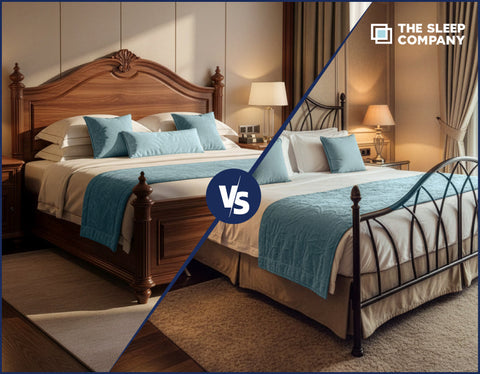
Here's something most people don't think about: your bed frame isn't just holding up your mattress -...
Read More
You've probably had this thought at least once, why does every hotel bed feel amazing while your...
Read More
Your mattress is probably the second-biggest purchase you’ll make after a car or home, somewhere between ₹15,000...
Read More
Your mattress collects roughly 500 million skin cells every year. Not a typo. That's half a billion...
Read More
What is SmartGRID? A Revolution for the Mattress Industry/Comfort Industry SmartGRID is designed with Japanese Patented Technology...
Read More
A major shift is underway in the mattress sector in India. Most Indians are ditching legacy mattress...
Read More
Do you wake up every morning with a serious dose of back pain? Then, a good orthopedic...
Read More
Queen Vs King Bed: Complete Size Guide for Indian Bedrooms Choosing between a queen bed vs king...
Read More
Which Mattress is Good for Health? Discover Several Benefits and How to Choose the Right One Do...
Read More
Soft, Medium or Firm Mattress (2025), Which is Best For You? Most people discover their mattress firmness...
Read More
Choosing the best mattress in India isn’t as simple as it seems. We get it! With countless...
Read More